Canberra Daily Publication of Tuesday May 26 2026 shown below:

Have we stopped asking questions? Mandatory Vaccination under the spotlight at Canberra event
May 19, 2026
Prior to 2021, most Australians likely felt little reason to delve into how vaccines available in Australia are developed, tested, approved and rolled out.
Nor had regulatory agencies like the Therapeutic Goods Administration (TGA) and the Australian Technical Advisory Group on Immunisation (ATAGI) become household names.
Since the COVID–19 pandemic, however, whilst vaccines have become the subject of intense and far-reaching attention, and most Australians are now familiar with the ‘TGA’ and ‘ATAGI’, the opportunity to discuss or raise queries about them and their function has not appeared equally popular.
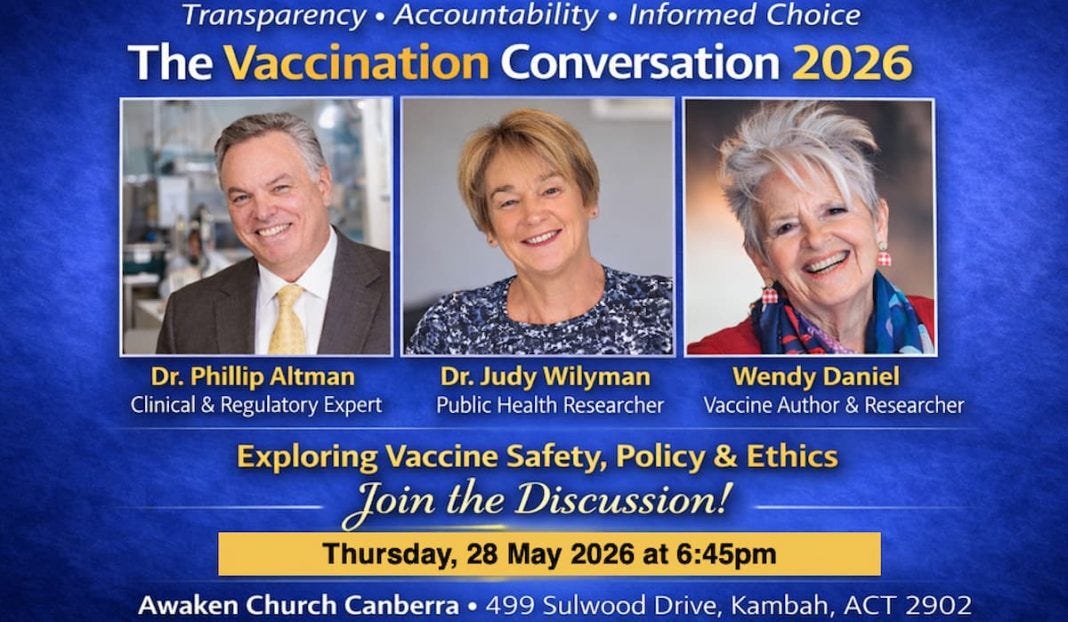
In response to this, three Australian experts and researchers, either on drug regulation or the history of infectious disease control in Australia, are presenting at The Vaccination Conversation in Canberra on 28 May.
Presenters include Dr Phillip Altman, Dr Judy Wilyman and Ms Wendy Daniel.
Ms Daniel is an author and long-term independent researcher into vaccine history, accountability and public data.
Dr Phillip Altman BPharm (Hons), MSc, PhD is an Australian authority on clinical trials and regulatory affairs with over 40 years of experience in the design, management and reporting of clinical trials.
Dr Judy Wilyman is a public health researcher whose PhD examined the historical control of infectious diseases and the influences shaping Australia’s National Immunisation Program.
Dr Altman reports he has worked alongside the TGA in gaining new drug approvals and has been involved in well over 100 clinical trials ranging from phase 1 to phase 4.
“I am not an anti-vaccine guy – I am a pro safety guy,” he says.
“I’m also probably the most experienced drug regulatory professional in the country and am retired, so can speak my mind and have no conflicts of interest,” he says.
Dr Altman may be referring in part to challenges claimed by health professionals in finding opportunities to discuss and raise queries around new vaccine technology or mandatory vaccination policies.
On 9 March 2021, a joint statement was issued by the Australian National Boards and Australian Health Professionals Regulatory Association (AHPRA), which advised, ‘There is no place for anti-vaccination messages in professional health practice, and any promotion of anti-vaccination claims, including on social media and advertising, may be subject to regulatory action.’
The statement also advised health professionals to report their concerns about the conduct or practice of a health practitioner in relation to their views or clinical practice around vaccination.
Dr Altman reports that this led to a culture of fear, where professionals did not feel able to engage in the scientific debate that medicine has always relied on because questions about COVID–19 vaccines or their safety for everyone were considered an ‘anti-vaccine’ sentiment by many.
“Experts with valid queries were censored,” he said.
“And I was previously the go-to guy for the TGA.”
AHPRA were contacted for comment.
Dr Wilyman believes that shutting down debate and ongoing examination has no place in the progress of medicine or science.
“We should be able to talk about risk without being labelled anti-vaccination, and to examine the evidence used to mandate vaccines,” says Dr Wilyman.
The Australian Government’s Australian Immunisation Handbook provides information to the public and guidelines for professionals on Australia’s vaccines and the policies regarding their use.
It refers to vaccines as ‘… complex biological products.’
The handbook stipulates that prior to taking a vaccine, ‘…the person must have the opportunity to seek more details or explanations about the vaccine or its administration.’
When were mandatory vaccine policies introduced in Australia?
“What we are examining during The Vaccination Conversation is the policy of mandatory vaccination, not the place of vaccines in general,” says Dr Wilyman.
2016 marked the first time that vaccines were mandated in Australia for children to be able to attend school and/or for their families to receive a family payment.
Federal parliament passed the legislation, the Social Services Legislation Amendment (No Jab, No Pay) Bill 2015.
From 1 January 2016, those with a secular or religious belief against vaccination were no longer eligible for certain family payments if their children were not up to date with their immunisations.
The Australian Medical Association says that ‘… immunisation is the most successful and cost-effective health intervention worldwide.’
And that, ‘All vaccines must be administered in accordance with relevant legislation, best practices, and the guidelines and recommendations outlined in the Australian Immunisation Handbook.’
The Australian Immunisation Handbook advises that for consent to be legally valid, it must be, ‘…given voluntarily in the absence of undue pressure, coercion or manipulation.
Prior to COVID–19, the Australian Health Management Plan for Pandemic Influenza (AHMPPI) (2019) did not recommend mandatory vaccination for the general public.
Instead, it focused on voluntary uptake through communication, surveillance, and providing free vaccines to high-risk groups.
Australia’s COVID–19 public health response, however, opted for mandatory vaccination to be used as a tool to contain the spread of the virus.
During the pandemic, then Federal Minister for Health, Greg Hunt, was widely quoted saying that “Vaccination is critical to protect aged care residents, and mandatory vaccination for workers is an important step to keep them safe.”
Each state jurisdiction in Australia was, however, responsible for devising its own rules around mandates, which varied in which workers were covered, how strict the rules were, whether booster doses were required, and how exemptions worked.
Victoria, Western Australia and the Northern Territory required broad community COVID–19 vaccine mandates necessary to attend work, a public event or a venue.
The ACT enforced mandates in the health, education and disability sectors only.
Tasmania did not impose vaccine mandates on the public beyond certain employment sectors.
Historically, the ACT, Tasmania and Northern Territory have not required vaccination to access childcare, preschool or primary school, unlike the remaining states, which remains the case. They do, however, still fall under the federal legislation which prevents the receipt of family payments for children whose vaccinations are not up to date.
Event organisers say that because the Australian Immunisation Handbook guidelines around consent, and the mandates which tie vaccination to employment, financial and social consequences, appear at odds, some Australians may remain confused around mandatory vaccination policies.
They add that the event is an opportunity designed to ‘…bring transparency, expertise, and open discussion back into the room.
“It is not a protest event, but a forum for serious inquiry to examine how vaccines are developed, approved, regulated, and integrated into Australia’s public health framework — and why informed consent, ethical governance, and open scientific discourse matter more than ever,” they say.
Further information on Australia’s immunisation policy can also be found at health.gov.au/topics/immunisation.
The seminar welcomes healthcare professionals, academics, students, policymakers, and members of the public who believe robust debate strengthens — rather than weakens — democracy and science.
The Vaccination Conversation 2026 is on Thursday 28 May, 6:45pm at Awaken Church, 490 Sulwood Drive, Kambah.
To book tickets, visit ticketebo.com.au/hear-our-voice/the-vaccination-conversation
“You know how everyone believes vaccines saved us from deadly diseases? That’s backwards. Deaths from diseases like measles, whooping cough, and scarlet fever had already dropped by 95% before vaccines were invented. What really saved lives was boring stuff—clean water, flush toilets, better food, and decent housing.
Here’s what happened: vaccines showed up after diseases were already beaten, like a firefighter arriving after the rain put out the fire, then claimed credit for saving the building. The real kicker? The “father of vaccination,” Edward Jenner, tested on his gardener’s kid with no scientific method whatsoever, and Louis Pasteur—the supposed hero of vaccines—was caught faking his data when researchers examined his private notebooks a century later.
Now we’ve got 1 in 36 kids with autism compared to 1 in 10,000 in 1970, right after the vaccine schedule exploded from 8 shots to over 70. The government knows vaccines cause injuries—they’ve paid out billions in a special vaccine court you’re not supposed to know about—but vaccine makers can’t be sued thanks to a 1986 law. They have zero incentive to make vaccines safer. We eliminated diseases through sanitation and nutrition, not needles, but there’s no profit in telling people to eat better and wash their hands”. Dr McCullough and John Leakes latest book written after a deep dive into the outrageous fraud of the ‘vaccines’ industry business model. One only needs the courage to lift the veil of criminality.
I am so grateful to the three of you for continuing to hold these authorities to account. I held out throughout the coercion from the Andrews Government, the rest of my family didn’t. I am still so angry for them although they won’t listen to you yet. You are truly heroic to me and I thank God for your tireless efforts. Also the 28th is my birthday which makes your forum extra special.